Mixtape #2: Guilt by Dissociation
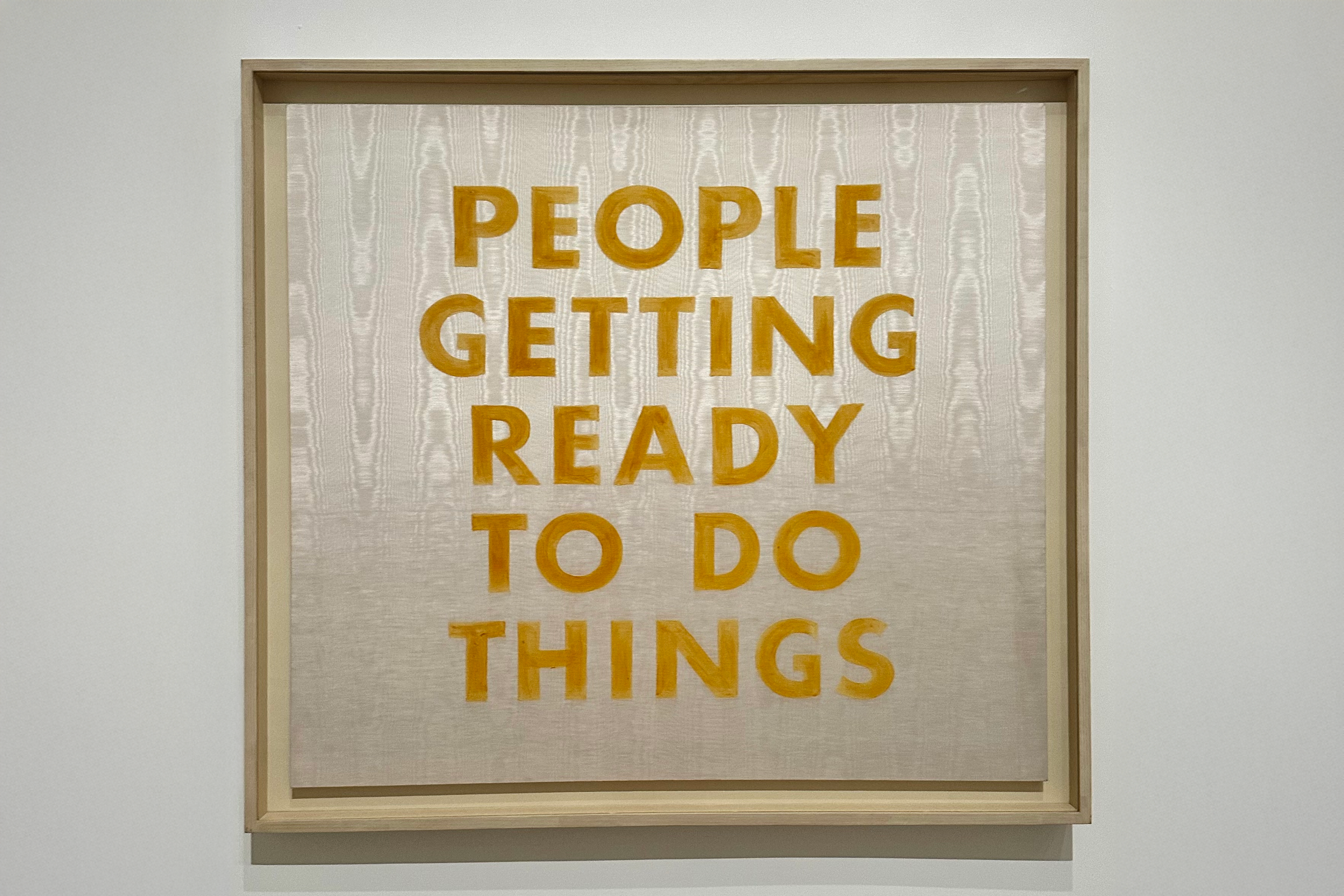
Ed Ruscha, People Getting Ready to Do Things (1974). Photo: Ava Tichenor
Welcome to “Mixtapes,” our weekly series of original playlists—inspired by our own respective, fondly remembered rituals of burning mix CDs for ourselves, special occasions, friends—aimed at capturing the essence of a particular feeling, moment, mood, or experience within the constraints of (roughly) the total audio minutes available on your standard compact disc. Every week, we’ll zoom in on something different, specific, and personally resonant and explore it with a shared playlist and some accompanying “liner notes.” Fresh mixtape published every Friday.
LINER NOTES
This week, multidisciplinary artist Issy Wood’s “Child’s pose” has, for some reason, resurfaced on my radar, and I’ve found myself listening to it on repeat. Wood’s characteristically offbeat indie-pop earworm—the closing track on her 2021 EP, If It’s Any Constellation—is lively and a little dystopian. At this particular moment—in the year, the world, my own life—it feels, profoundly more so than it did upon its release some five years ago, captivatingly resonant.
It bears, in force, all the signature trappings of pop, with its colorful and upbeat sonics, dulcet vocals, electronic beats, and liberal application of ’80s synth-pop hallmarks, most notably her prevalent multi-tracking and, of course, distinctive and prominent Juno-106 usage (a fixture throughout Wood’s 2021 EP, and a defining sound of the subgenre).
It’s upbeat and unsettling and darkly comedic. Wood, quite literally, does not skip a beat before diving right into the subversively energetic, lyrically loaded first verse, which only takes three words before it arrives at “traumas.” By the second half of the verse, though, you can’t help but find yourself singing along as you hear your own voice repeat aloud, “Oh, once it’s normal to drink / And kind of hope you drown / You know you’re really alone,” even if this inadvertent moment of introspection may feel a bit uncomfortably close to home.
Wood’s second verse aptly sets the stage for the rest of this week’s mix, with her self-aware, if sardonic, lyrics comprising a stirring portrait of someone confronting the weight of once-coveted adulthood and the aloneness of the independence it both bestows and imposes. Here, teetering between doing and dissociating, paralyzed by the prospect of commitment, and acutely aware of her avoidance and ambivalence, her admission itself remains safely distanced by irony and dryly witty, mocking metaphor.
“I’ve only got one foot in / I keep the other out,” Wood sings. “I should take that leap, but I don’t / Thought I knew what I was in for growing up, but now / I’m moving to,” she continues, teetering, melodically, just on the brink of handing over the resolution of the classic pop hook we’ve been awaiting before disrupting it right at the moment of its expected occurrence, instead landing on the drawn-out, hesitantly delivered “child’s po-oh-oh-se.”
Like many of us who have, at one point or another, identified with her sentiments, Wood ends the verse declaratively, “just hop[ing] nobody knows.” Maybe that has something to do with the fear or expectation that the resulting response will only further the isolation she feels: “You want some help?” Wood imagines the reply, “You’re on your own.”
Wood closes by deliberately distancing herself: “Maybe just leave me alone / I’m better off on my own,” she hesitantly offers, and then, as if attempting to convince herself, concedes. In doing so, she postulates, wishfully, “Maybe I’ll show you just how much I’ve grown”—not by virtue of doing so, necessarily, but, rather, by appearing as if she has, at least from the distance she’s created. The song’s final line—“But let’s do that over the phone!”—in this light, is honest, self-aware, and genuinely funny.
This Is Lorelei’s—that is, musician Nate Amos’—advance single “Oh No Now My” from his latest record The Singer in My Band (out today) is an (also characteristically) offbeat, emotionally charged, indie-rock anthem. The track feels loaded with a combination of frustration, guilt, and cautious compassion directly addressed to a “Joey.” “I wish you wouldn’t mess around so much,” Amos pleads, in the same register as he subsequently delivers the almost threatening line, “If the kid comes out, I’m kicking your crutch” and, later, the remorseful-sounding, “I don’t wanna let you miss so much.”
The song’s title and its most frequently occurring lyric, “Oh no, now my,” stops just short of naming the possessive object, leaving us hanging and wondering each time the phrase recurs. Likewise, the central IV-V-vi-V chord progression paired with the prominent, unwavering drumbeat affords the song a similarly almost-but-not-quite-cathartic feel to Wood’s preceding track. Here, we have the sense of cyclical, driving momentum that builds to a tense peak and, rather than resolving, leaves the listener hanging as it drops back down to the fifth, only to restart the same loop.
Saint Saviour’s “Poetry” gives us the progressive build and cathartically culminating ending the two preceding tracks teased and left us craving. The song, according to alt-pop artist Becky Jones who performs under the moniker Saint Saviour, is “an existential song about embracing the great mystery of love. There’s a link to Kierkegaard’s idea of ‘becoming’ which [she] was playing with with the chorus’s concluding line.” Jones describes it as “the closest… [she’s] ever got to a lyrically simple song about love without subverting too much.”
Despite the song’s more musically gratifying structure, feeling of optimistic wonder, and sense of forward progression, lyrically, the song intentionally cuts itself off before coming full circle to a neat conclusion. “In the studio,” Jones describes in her (previously quoted) 2023 commentary following the track’s release, “wonder[ing] if the song needed another verse,” but ultimately deliberately leaving one out, in her words, “to allow the listener to reflect.” In its place, she and producer Bill Ryder-Jones instead let sound articulate what words themselves explicitly do not, with what Jones describes as “this incredible explosion of noise around what was originally a sad little whistle solo.”
A real, experienced “feeling” remains an inarticulable “Mystery,” “Memory” is “fleeting / Evaporating,” love “Keep[s]” you “dreaming”—”It’s all poetry.” Like poetry, this lives in the realm of the abstract, despite the desire for something concrete—as Jones laments: “Wish I could hold you / Cling to your meaning.” Even as we seem to approach, “little by little,” the desired understanding and tangible connection we seek, once finally within range, it is already “becoming sunshine.”
Iron & Wine’s “California Sober,” released last month as an advance single ahead of the forthcoming deluxe edition of album Hen’s Teeth (out September 22), deals also in abstractions, though notably more cynically. If the track bears, as label Sub Pop describes, a “playful nature,” it lies in Sam Beam’s evocative, cleverly crafted, and wryly reflective, if at times bleak, lyrics.
Beam pulls no punches with his opening line, “poison’s in the dose”—a fitting echo of Wood’s earlier drink-and-hope-you-drown remark, and an artful lead-in to the lyric from which the song derives its title: “Among these mediocre / California sober.” Where Wood’s mocking emblem for “wellness” was yoga, Beam’s is “California sober”—a half-measure masquerading (perhaps for the sake of self-deception) as health regimen.
To this end, “Dreaming all the water they can drop” deftly invokes and inverts idiom, suggesting outsized dreams that don’t hold water and, left unrealized, are continually replaced with new, ill-fated ones that materialize just as quickly as they are eventually discarded.
Perhaps the line that hits most poignantly (for me, at least, a native Angeleno) is Beam’s lyric about “Only driving ’cause the traffic ain’t too bad.” Oddly specific and surprisingly literally relatable, the real resonance lies in the localized, but also much more broadly applicable, tendency to seek motion purely for motion’s sake—or, perhaps, for the pretense it affords us to buy into its illusion. We like the semblance of momentum, especially—somewhat ironically—when we are still struggling to determine our intended destination.
A retrospective reflection on a life thus spent, we later land on “You and your December brides”—the marriages, presumably, we settled for after idly waiting long past our planned timelines for the ones we had once envisioned never to actually transpire. Here, we’re confronted with the consequence of avoidance—while we were putting off deciding where we wanted to go, we inadvertently already arrived somewhere far astray.
As Beam unhesitatingly reminds us, our present melancholy is entirely our own making. After a lifetime of possibilities frittered away through unkept promises, unchased ambitions, undetermined intentions, really, “What’d you think would happen?” Beam’s ending on a single, repeated line feels almost like a premature elegy for the ineluctable, disappointing future of someone who can’t help “Leaving all [their] feathers in the wind.”
“Hush your mind,” at this particular moment, feels like welcome advice at the start of The Smashing Pumpkins’ “Simmatar,” one track in a ’65- and ’66-British-psych-indebted batch that originally cropped up as seven-inch singles within the ATUM (2023) box set prior to being sequenced, late last year, and released as their own standalone album, Zodeon at Crystal Hall. Cut live to tape, in mono, during the pandemic, it bears the distinctively unhurried, analog warmth of a period Mellotron. As the track vacillates between conflicting concurrences—“Times are bad / But good”; “We hunger, understand,” “We understand,” and “We under-understand”—the refrain of those initial three words, repeated sequentially, becomes a sort of mantra. Time continues on unrelentingly, whether “Times are bad” or “good,” no explanations, no resolutions, and no outcomes guaranteed. There may be some peace in pure, mindless acquiescence to the messiness, complexity, unpredictability of existing—maybe not every mystery needs to be solved. But, then again, if it were that easy to “Hush your mind,” we might not need the recurrent reminder.
We do get a brief reprieve, though, as we hit the halfway point. Byron Bay band Babe Rainbow’s “Acid and Honey” earns its blissfully stationary six minutes by asserting the space to exhale amidst the emotionally fraught, compulsively overthought surrounding lineup. This is the tracklist’s lengthiest title by nearly two full minutes yet is built from exactly two verses, looped and recast in shifting inflections atop an unhurried, lo-fi beat, wah-wah guitar, and dueling synths. If only for a moment, here, “It’s your life, you know enough,” so stand still, and enjoy it.
As the recurring verses return, seemingly a little less self-assured with each reiteration, “Drive fast… You’re not fast enough” starts to feel more imperative than, as it did at first, ironic. Even standing still will catch up with you eventually, apparently.
Unfortunately, the compulsion toward movement doesn’t necessarily come with a map. Stuck squarely between propulsion and paralysis, Squirrel Flower’s “Say a Prayer to the Gods of Getting Going,” the title track on her latest album, which artist Ella Williams released the same month she turned thirty, somehow captures the specific, transitional moment in one’s life characterized by the intractable, opposing, simultaneous pull between childhood and adulthood, unreadiness and expectation, stasis and progression—so, Williams decides, with equal reverence, to ”Say a prayer to the gods of getting going / Say a prayer to the gods of standing still.” Then, outright, she confronts what we realize we have, until now, been circling but too afraid to directly confront: “I feel glory passing by,” she sings, “In five years what will be growing? / Can I water the concrete?”
Whereas “Say a Prayer” concludes on an open question of what the future will hold, The Zombies’ “Care of Cell 44” definitively indicates what’s to come and instead leaves us wondering how and why we got here. Though released nearly sixty years prior to “Say a Prayer,” this is another incisively discordant take on freedom and confinement. The song opens Odessey and Oracle (1968) with a bright and spirited flurry of harpsichord, Mellotron strings, stacked, sunshine-pop-style harmonies, and buoyant, hooky melodies. Recorded at Abbey Road in 1967 under the working title “Prison Song,” the joyful, airy track, which begins with an enthusiastic “Good morning to you” barely hints at the song’s underlying premise before we finally realize, after nodding along for an entire pleasant, poppy verse, that the subject of the song is, in fact, the addressee’s “prison stay.” Despite having been an utter flop upon its initial release, “Cell 44” has since grown into its audience and gained resonance for its subtly ironic, compellingly unexpected juxtaposition. Pitchfork later named “Cell 44” 98th on its list of “The 200 Best Songs of the 1960s,” aptly describing it as “the sunniest song ever written about the impending release of a prison inmate.”
While “Cell 44” is a letter written in anticipation, Brooklyn-based British-born musician Fenne Lily’s “Thank You Sorry” counters as a disappointing reply. Written on the heels of a breakup (“over the phone on Independence Day,” according to Lily), this is a cuttingly apathetic, stony rejoinder dressed in the trappings of an intoxicatingly pretty song. Nothing bears a more gratifyingly icy sting than answering the person leaving you with “it’s all the same to me.”
Despite her own admission that this now-failed relationship “took me further from where I wanna be,” this isn’t the resigned voice of someone who regrets “Leaving… feathers in the wind,” nor of someone willfully trying to “hush [their] mind.” She’s not “say[ing] a prayer” to any god, and she’s certainly not “standing still.”
The phone that Wood uses as a means of avoidance in “Child’s pose” reappears here, with the fateful call “on July fourth on a bad line,” but, this time, we’re on the real-life receiving end of the avoidance Wood earlier only joked about. And, this time, it becomes patently clear that the person “show[ing] you how much [she’s] grown” is not, in fact, the one hiding behind a receiver.
There’s a somewhat (no pun intended) poetic echo of Saint Saviour’s “You’re becoming sunshine” in Lily’s self-proclaimed resolve “to make music that sounded like the sun was out. “Love, relationships, people, external circumstances may come and go and take you by surprise, so Lily isn’t relying on “fleeting,” “evaporating” love as her source of light—she’s becoming the sunshine herself.
The next track, another thank-you letter, is acutely aware of the pervasive, persisting presence of the past. In “All I Think About Now,” The Pixies begin by unabashedly borrowing the nearly universally recognizable riff from their own canonical hit “Where Is My Mind?” (1988), instantly invoking the past’s vocabulary before even singing a single word.
(The song, quite literally, is a thank-you letter: bassist Paz Lenchantin, who joined after Kim Deal’s 2013 departure and sings lead here, asked Black Francis to write the lyric as a note to Deal, whom she had never personally met. So, this track is an expression of gratitude dedicated to the former bassist, sung by her replacement, over the band’s own borrowed riff.)
Nearly three decades after having posed the aforementioned question, it seems The Pixies have, in time, arrived at the answer: “I try to think about tomorrow / But I always think about the past / About the things that didn’t last.” The lyrics are unembellished and candid, and when words alone are insufficient, the reprise of the familiar tune does the heavy lifting. This is the dilemma every dissociator has, at one time or another, mistaken for refuge: “If I could go to the beginning / Then for sure I would be another way / Make it better for today.” But, when the song arrives at “I remember we were happy / That’s all I think about now,” the implication feels clear that, while the past may be an easy place to hide, it is, by nature, one that’s haunted.
Phoebe Bridgers’ house, on the other hand, is decidedly (and expectation-defyingly, given this next track’s title) not. In fact, “Haunted,” from last month’s album Lost Weekend, begins by clarifying, “It is not this house that’s haunted / But I don’t want it either way.” In the (remarkably intense) six years between her preceding solo album, Punisher (2020), and Lost Weekend, Bridgers’ perspective has, naturally, shifted in myriad ways. The departure between Punisher’s haunted houses—in “Garden Song,” she sings “Everything’s growing in our garden / You don’t have to know that it’s haunted,” and in “I Know the End,” she imagines living in “A haunted house with a picket fence”—and this line feels emblematic.
Reality, as it turns out, can be just as formidable a culprit. She’s disposed of the paranormal justifications, but her insomnia nevertheless persists: “I’ve been daydreaming about sleeping / But by the evening, I’m wide awake.” After ten tracks rife with avoidance, escapism, self-delusion, and deferral, we finally find ourselves facing reality head-on, only to discover that the feeling of profound disjunction can occur even when you are not arming yourself with a mental escape hatch.
Bridgers grapples with these frictions and fragilities throughout the song with striking self-awareness. “I have no secrets, only feelings / And I know those go away,” she sings, “There is a difference / Between lying and deciding what not to say.” The preceding songs have all centered, in some way, around what they crucially left unsaid, yet Bridgers is the first to articulate a vital distinction between “lying” and discretion, and it hinges on the act of “deciding”—I’m not convinced that any of the prior tracks really do.
The past, which looms large throughout this tracklist, remains as constant here as ever. Bridgers, however, has notably changed the terms on which it’s met: “If you’re gonna make a wish, then / You better be specific / You’re gonna have to live it every day.”
As we near the conclusion, and backing vocals by boygenius bandmates Lucy Dacus and Julien Baker begin mounting into the distinctive, unconventional, rich harmonies that have become the trio’s hallmark, Bridgers delivers the song’s revelatory moment with unaffected rawness and sincerity: “I’m gonna put myself together / You can go or you can stay / I’m gonna put myself together either way.”
Which leaves Wilco’s “Sunlight Ends” to close—and, fittingly, it refrains. Produced by Cate Le Bon for 2023’s Cousin, the track is an opaque and somewhat equivocal love song that sets sparse, indirect, starkly symmetrical lyrics against a coarse mechanical drum loop, muddled ambient synth notes, and a cascade of off-balance guitars. This is the inverse, in other words, of a preceding set largely characterized by sonic sweetness delivering a lyrical sting.
Jeff Tweedy defines his subject in purely relative terms, using negation and metaphor to construct, ultimately, only a vague and abstractly rendered silhouette—”not the kind of city street,” but “the kind of spinning star”; “not the kind of mountain stream” nor “desert sand,” but “the kind of flashing sign”—until he lands, appropriately, on “the kind of missing page / That only gets you lost” (Saint Saviour, you’ll recall, left hers out deliberately).
And, the “sunshine” that Saint Saviour’s subject in “Poetry” was “becoming,” and which Lily resolved to become herself, appears once again, finally, as something we find ourselves compelled to follow, but only “Until the sunlight ends.” Devotion, here, has an expiration—a reality that, though notably devoid of “poetry,” may, in a sense, be the most romantic depiction of love we’ve seen yet: an unabashedly honest one.
After eleven tracks of hiding, hedging, hushing, hesitating, and, ultimately, facing, we find ourselves, with this final track, concluding not in any culminating achievement or resolution but, rather, with our final steps towards the starting line. We are, indeed, “gonna put [ourselves] together,” but the unembellished truth is that we still have work to do.
So, the mix ends with us finding—and plainly admitting—we’ve gone astray: “And you’re lost / And I’m lost.” We may be lost, but, this time, all hope is not. Though we’re unsure where we are, we know definitively where we intend to end up, and we’re ready to face the reality we find ourselves in, however unsavory. There’s something that feels almost generous about closing on two people who have stopped pretending to know where they are, in the last of the light, still moving anyway.
If there is guilt to be found in any of this—the dissociating or the deferring, the phone calls or the finger quotes—it is mostly by association: twelve songs that, only in their collective grouping, happen to catch one another in the same act.
— Ava
TRACK LISTING
Child’s Pose
Issy Wood, If It’s Any Constellation (Zelig, 2021)
Oh No Now My
This Is Lorelei, The Singer in My Band (Matador, 2026)
Poetry
Saint Saviour, Sunseeker (VLF, 2024)
California Sober
Iron & Wine, Hen’s Teeth (Sub Pop, 2026)
Simmatar
The Smashing Pumpkins, Zodeon at Crystal Hall (Martha’s Music, 2026)
Acid and Honey
Babe Rainbow, Acid and Honey (Eureka, 2026)
Say a Prayer to the Gods of Getting Going
Squirrel Flower, Say a Prayer to the Gods of Getting Going (Polyvinyl, 2026)
Care of Cell 44
The Zombies, Odyssey and Oracle (Marquis, 1968)
Thank You Sorry
Fenne Lily, Win Win (Kiss Me Bite Me, 2026)
All I Think About Now
Pixies, Head Carrier (Pixies, 2016)
Haunted
Phoebe Bridgers, Lost Weekend (Dead Oceans, 2026)
Sunlight Ends
Wilco, Cousin (dBpm, 2023)