
Double Feature: Do the Right Thing / Grand Budapest Hotel
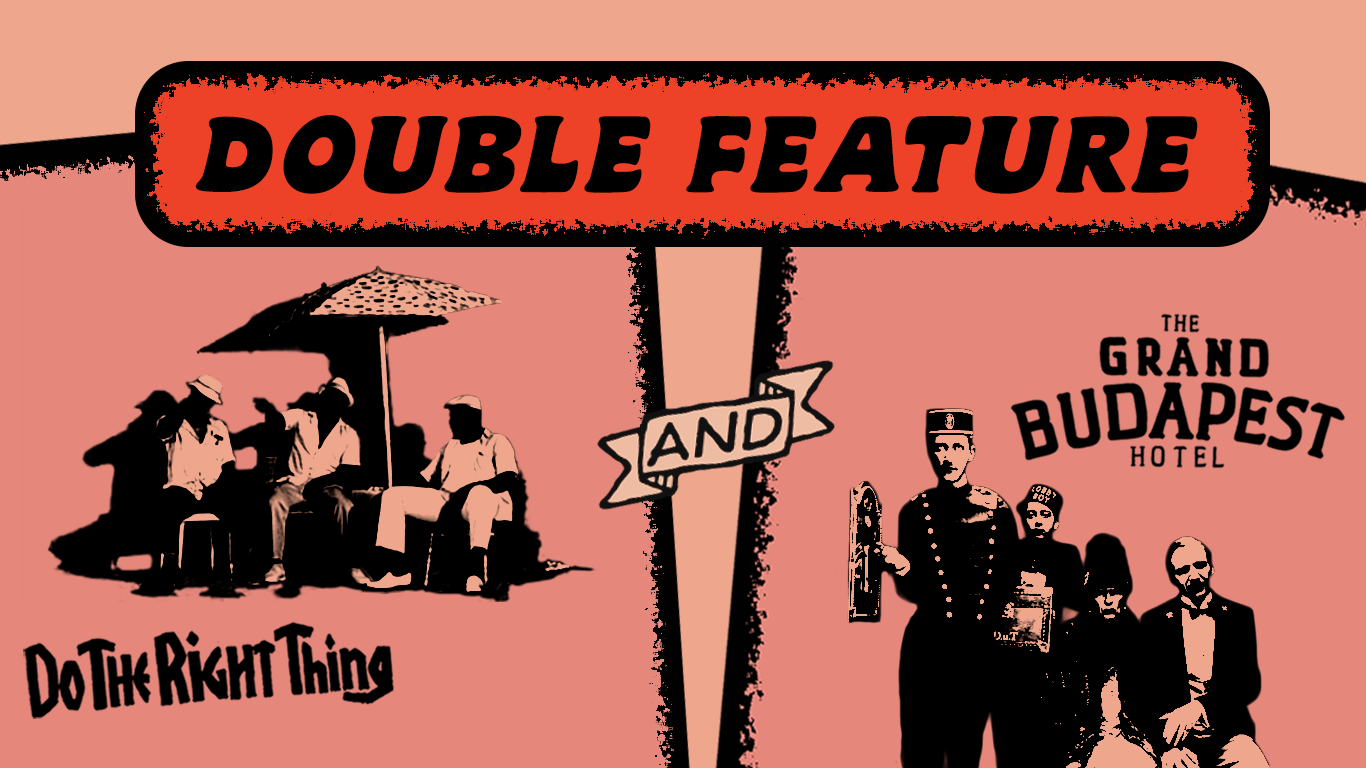
This is the first installment of our new, recurring column “Double Feature.” Every Wednesday, we’ll publish the week’s program—an often somewhat unexpected, thoughtfully selected pairing of two films to watch sequentially, from the comfort of your own living room, chosen specifically because something in each becomes legible only beside the other. We present the picks, specify the viewing order, make our case for the pairing, and leave the watching to you.
It’s hot in Los Angeles right now, and I don’t want to go outside, so I selected two films that prominently deal with temperature. I love both of these films. They’re accessible flicks from two auteur writer-directors. They’re important. They’re fun. They’re sad. Let me say this: No one wants to watch two deliberately “paired” films back-to-back unless they produce four hours that miraculously change your outlook on life with their communion. Obvious double features with expected similarities shall therefore be avoided. So, let’s shake it like an inconvenient strip of 16-millimeter film—and then go to bed!
Who to watch with: Your friends or your family. Hopefully there’s an unspoken yet tangible political difference in the group. Hopefully it’s your friends and your family. It’s even better if it’s your friend’s family. Why put yourself through watching this double feature with your own family? No, it’s much better if it’s your friend’s family. Bonus points if it’s hot outside. Let’s break the heat and crack this ice, then.
Do The Right Thing (1989), 120 min., dir. Spike Lee
The viewer swelters alongside the characters in Spike Lee’s Do The Right Thing (1989). The story transpires over the course of a chaotic summer day in Brooklyn. It's too hot to fight, and “it’s too hot to fuck.”
The characters are proper New Yorkers. The main character, Mookie (Spike Lee), is a well-liked pizza-delivery boy who navigates the lively Brooklyn neighborhood. Sal (Danny Aiello), Mookie’s Italian employer, owns a pizzeria with his two sons Pino and Vito. Pino (John Turturro) bullies Vito (Richard Edson). Pino also detests his father’s reliance on a black neighborhood to make the nut.
Many of the interactions and stories transpire as Mookie navigates each block with warm pizza in hand. Mookie’s Italian employers, black brothers and sisters, and Puerto Rican friends comprise the dynamic tapestry he navigates. The Koreans don’t much care for the tapestry, and the whites are fascist cops who would rather piss on the tapestry, but all characters have side stories and vignettes that meaningfully thread its fabric. Tensions build, the heat breaks, the sun disappears, and Do The Right Thing ends. Then, the viewer’s speculation starts.
“Laughs come from the passed-down wisecracks and the improvisation.... When the most harrowing truth of all is depicted, though, there is nothing funny about it.”
A minor character that harmlessly bludgeons into the story now and again is the scene-stealing Radio Raheem, played by Bill "I-Heard-Spiderman-Was-There" Nunn. Raheem itinerantly moves through the neighborhood blasting Public Enemy’s "Fight The Power" on his badass boombox. Raheem is a loner. In the opinion of this writer, he is autistic. It is one of many honest depictions of folk in a lively New York City neighborhood. I sympathize with Raheem’s shyness and lack of communication skills. His inability—whether personal or institutional—to express his feelings of estrangement (or just his love of hi-fi music) is tactfully shown.
I found myself laughing. While Do The Right Thing is “funny,” it’s not because of jokes and punchlines. I laughed at Spike Lee’s unapologetically authentic direction. Laughs come from the animated physical performances of talented actors like Giancarlo Esposito, John Turturro, and Rosie Perez. Laughs come in the forms of passed-down wisecracks and improvisation, but there is rarely a literal joke. Native Brooklynites will rejoice, and anyone else will watch with fascination, a community so colorful. Spike Lee, a Brooklynite himself, characterizes the neighborhood sincerely and truthfully. When the most harrowing truth of all is depicted, though, there is nothing funny about it.
Despite the fireworks that transpire in the final 30 minutes, we are left in a sort of sad reflection. It’s not a reflection from the pool of sweat at our feet. It’s a reflection of American society’s perpetual issue of race relations, misunderstanding, communication, trust, and betrayal. If this movie had a cut-and-dry morality, we wouldn’t still be talking about it nearly 40 years later. It’s a good film because it makes audiences feel multiple complicated emotions. The viewer would go to bed harrowed should it be viewed last.
Moments of improv: John Turturro spazzing on Smiley when he and his father are speaking in the pizza shop.
The Grand Budapest Hotel (2014), 104 mins, dir. Wes Anderson
Your glands will cool once you are in the embrace of the whimsical charm of Wes Anderson’s The Grand Budapest Hotel (2014). Yes, the film came out in the fall or the winter or something. Yes, there is snow. But, during the summer we eat garden salads and snow cones, and we drink Aperol Spritzes and lemonade. Why would another hot and sweaty film with a warm color grade serve this double feature well?
Most sound-minded people will hesitate to jump right into another film immediately after the harrowing emotional rollercoaster of Do The Right Thing. However, if you, like I, have, like, so many things to do, and if you tend to procrastinate procrastination procrastinatingly... The inviting black screen will offer another two hours of fun after the double-feature intermission when the studio logos start.
The narrative structure of Grand Budapest Hotel is what Do The Right Thing might consider a fantastic tale. Well, The Grand Budapest Hotel is indeed a fantasy. The fictional-European-nation-set “fantasie” is a story passed down, like a Brooklyn wisecrack, through generations. The central storyline may as well take place in an architecturally striking diorama of a snow globe given to your grandmother, by her grandmother. By minute ten, we are inside the snow globe, with an obnoxious child shaking it harder and harder before growing bored and setting it back down on a shelf. As we approach the 65-minute mark, even the most impatient viewer there experiences a second wind of adrenaline. We have unknowingly enveloped ourselves in this hear-tell-snow-globe-fantasy diorama without even having realized an hour has already passed.
The characters simultaneously express convincing mourning, longing, and a lust for youth. The story unfolds as Zero Mustafa (F. Murray Abraham), mysterious owner of the Grand Budapest, recounts to "The Writer" (Jude Law) his quietly devastating nostalgia for a time bygone, back when the Grand Budapest Hotel was an illustrious destination, and when he first fell in love.
The Grand Budapest Hotel’s central story concerns a charming concierge at the Grand Budapest, Monsieur Gustave H. (Ralph Fiennes) and his industrious bellboy, a much younger Zero Mustafa (Tony Revolori), as they uncover a sinister conspiracy while relying on their newfound friendship. They respect one another despite their differences in skin color, background, or proclivities. They seek to vindicate themselves from accusations of murder. An aggressive regime change is underway in the fictional European nation—a clear stand-in for the Nazi invasion of Poland.
The characters, albeit to a slapstick extent, depict convincing human emotions. At risk of sounding like a boys’ Christian retreat counselor, the characters express courage, camaraderie, and fellowship, depicted in moments like young Zero’s selfless attempt to save Monsieur Gustave H. from prison, and even when Zero holds up a menu to conceal a woman’s plucking her chin hair from bystanders in the lobby. Zero and Monsieur Gustave H. both love their work because they both love people. These acts of empathy add new shades to Zero and Monsieur Gustave H.'s developing mentor-mentee relationship. Monsieur Gustave H. never relents in his defense of the brown-skinned Zero against the fascist invaders.
“The adolescent Zero Mustafa... is the person we all wish we were some-odd years ago—especially those of us who now spend our evenings watching double features. ”
The Zero Mustafa with whom we spend the film’s opening and closing scenes is a regretful old man, but he accepts the beauty of his memories. The adolescent Zero Mustafa with whom we spend most of Grand Budapest is fresh and vigorous, not older than eighteen. He is the person we all wish we were some-odd years ago—especially those of us who now spend our evenings watching double features.
Moments of improv: Harvey Keitel slapping Zero in the face.
Closing Thoughts
I ruminated on whether or not I could finish this double feature with The Grand Budapest Hotel. It felt almost insulting to begin such a charmingly whimsical film in the immediate wake of Do The Right Thing’s crowd-hushing finale. It was then that I came to the conclusion that both films are ultimately about life and death, though they each frame the relationship differently. Do The Right Thing barely has time to contemplate—the story moves on a trajectory of modern-day-New-York urgency, despite being “slower” than Grand Budapest. Grand Budapest is more contemplative, despite being frenetically plot-focused in comparison to Do The Right Thing. The Grand Budapest Hotel transpires over a century, whereas Do The Right Thing occurs within the span of a single day. To quote Cormac McCarthy: “If it doesn’t concern life or death, it’s not interesting.”
It perhaps makes sense, given the apparent “heat wave” theme, to pair two films featuring themes of temperature and life and death and humanity and generational relationships that both depict hot weather. I must ask you this, though: When it’s one hundred degrees outside, do you want a hot plate of lasagna for dinner, when you’ve had a fried catfish sandwich for lunch? Embrace the chill. It’s none of my business, but when it’s one hundred degrees outside, there’s no business like snow business.
Tangentially related notes that didn’t make the article…
The 180-degree-rule famously broken in Yasujirō Ozu’s Tokyo Story (1953) is frequently replicated in Do The Right Thing to evoke a palpable sense of first-person antagonism for the viewer, whom is placed directly on the receiving end.
Another midcentury black-and-white film, Night of the Hunter (1955), is echoed in Raheem’s monologue about love and hate.
Both The Grand Budapest Hotel and Do The Right Thing rely on delicious boxed food to advance their plots and depict community.
I said there are not many jokes in Do The Right Thing. The first actual punchline comes from the bike-riding yuppie telling Buggin’ Out and friends: “I was born in Brooklyn!” after he scuffs Bug’s kicks.
Two pieces of dialogue in Do The Right Thing were somewhat implemented by Quentin Tarantino a few years later in his first two breakout films: True Romance (1993) and Reservoir Dogs (1992)—ironic considering the two filmmakers’ combative relationship in the subsequent decades.
“And you know what they say about the Italians…” – Dennis Hopper’s masterfully performed monologue in True Romance provides us with the answer.
“You better wake up and apologize!” – Harvey Keitel’s line in Reservoir Dogs, “You shoot me in a dream, you better wake up and apologize,” notable echoes a similar line from Do The Right Thing: “If Mike Tyson dream about whupping my ass, he better wake up and apologize.”
Where to watch: I streamed Do the Right Thing on my girlfriend’s YouTube-Plus-Max-Prime-Plus account and I streamed The Grand Budapest Hotel for free on a website of somewhat dubious provenance (yes, I had seen them both many times already).
Editor’s note: You can stream Do the Right Thing via Apple TV or Amazon Prime Video’s ALLBLK channels, free with ads on Youtube Free, or rent the movie for $3.99 on Apple TV or Amazon Prime Video. You can rent The Grand Budapest Hotel for $2.99 on Apple TV or Amazon Prime Video.