Greetings From the Dream Factory
Courtesy of Helms Design District
This article was authored by Ava Tichenor (Editor-in-Chief) and Andrew Niklas Curtis (Executive Producer) as the introduction to the October 2026 print edition (Issue 01: Lore) and originally released on October 10, 2026 at the Factory Settings popup in the Helms Design Center during the Culver City Arts Festival.
“Certainly no folk hero or god has ever been known so intimately by his admirers as are the movie stars. But, of course, none of the ancient gods had publicity departments.”
Cultural anthropologist Hortense Powdermaker popularized Los Angeles’ long-famous epithet in her 1950 book, Hollywood, The Dream Factory, containing her published findings on the social structures underlying Hollywood. Over the span of a year and a total of roughly 900 interviews with 300 industry workers, Powdermaker’s account of the inner workings of the Hollywood “Dream Factory” conveys the perspective of an experienced, systematic social scientist (she was).
Powdermaker’s prior fieldwork had taken place studying the cultures of a small village in New Ireland and a Mississippi Delta cotton town. She applied the same methodologies she had there to Hollywood, cataloging its taboos, rituals, “myths, folktales, and gossip [that] were all relevant to understanding it,” the “men who played god” and its “lesser gods,” and the folk gods, heroes, and legends the industry mass-produced and distributed not only to the American public but exported worldwide. She treated cinema itself as the country’s popular mythology, satisfying, “man’s need for escape from his anxieties,” “help[ing] assuage his loneliness,” “giv[ing] him vicarious experiences beyond his own activities,” and “portray[ing] solutions to problems,” and “provid[ing] models for human relationships, a set of values and new folk heroes.”
“The movies,” she writes, “are the first art form of any kind, popular, folk, or fine, to become a trust,” with big business, mass production, and distribution bigger still. As for the ‘product’ coming out of these assembly-line-like manufacturing systems: “Hollywood is engaged in the mass production of prefabricated daydreams. It tries to adapt the American dream that all men are created equal, to the view that all men’s dreams should be made equal.”
Powdermaker was careful, in her writings, to refrain from prescriptive pondering or passing value judgments of her own. Though the label had decidedly not been intended as a compliment, it was incisive, sharp, evocative. So, the city recast it with the air of excitement and intrigue and eagerly adopted it as part of its brand.

Illustration by Ava Tichenor
The place the name denoted was never a single pin on a map—Hollywood was an idea, a brand, to some, even a mythic idyll, not only the producer of dreams, but a dream in itself. It is emblematized in the familiar sign on the hill, which is perhaps the most widely recognized visual representation of Los Angeles even today (somewhat fittingly, the Hollywood sign, which first read “Hollywoodland” at its unveiling in 1923, was actually an advertisement for a new housing tract occupying a subsection of the Hollywood area).
The manufacturing, however, often took place elsewhere—Burbank, the San Fernando Valley, Universal City. And, a square mile in the southwestern portion of L.A.’s sprawl that would call itself, on its civic seal, “The Heart of Screenland.” This square mile belonged to Harry Culver, a real-estate man who announced his eponymous city in 1913, incorporated it in 1917 and needed an industry to fill the then-vacant lots.
He found one in Thomas Ince, who had invented the “assembly line” model for moving pictures at his pioneering studio, Inceville (an 18,000-acre development located around what is now the intersection of Sunset and PCH). By 1915, Ince was looking to upscale his operation with new dedicated production facilities built from the ground up. The studio he placed on Washington Boulevard eventually became studio-era king Metro-Goldwyn-Mayer’s and, today, the Sony lot. The second lot he built, just down the block in 1919, The Culver Studios, was the eventual shooting backdrop for films including Citizen Kane, Gone with the Wind, and King Kong. Despite living up to the motto emblazoned on its official seal, to the vast majority of nonlocal filmgoers (or, more commonly today, streaming service subscribers), Culver City retains its relative obscurity in the legendary Los Angeles imaginary landscape.
In 1924, Culver opened a hotel on the city’s main street with his own office upstairs, and in November 1938, Metro checked in 124 members of Leo Singer’s troupe for the filming of The Wizard of Oz—three Munchkins to a bed (sideways, as their small stature apparently allowed) at fifty dollars a week (Toto’s trainer was paid one hundred and twenty-five). Legend has it that their stay comprised ongoing debaucherous revelry amongst the group.
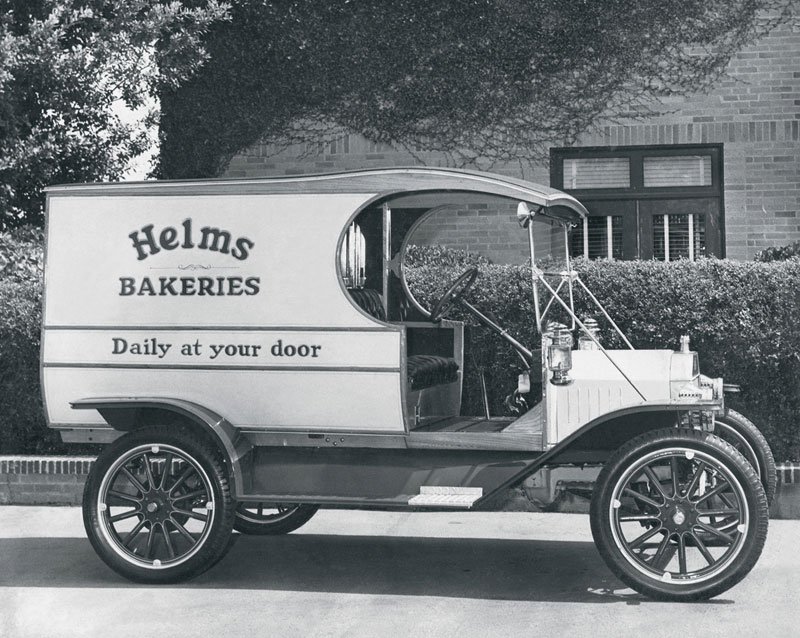
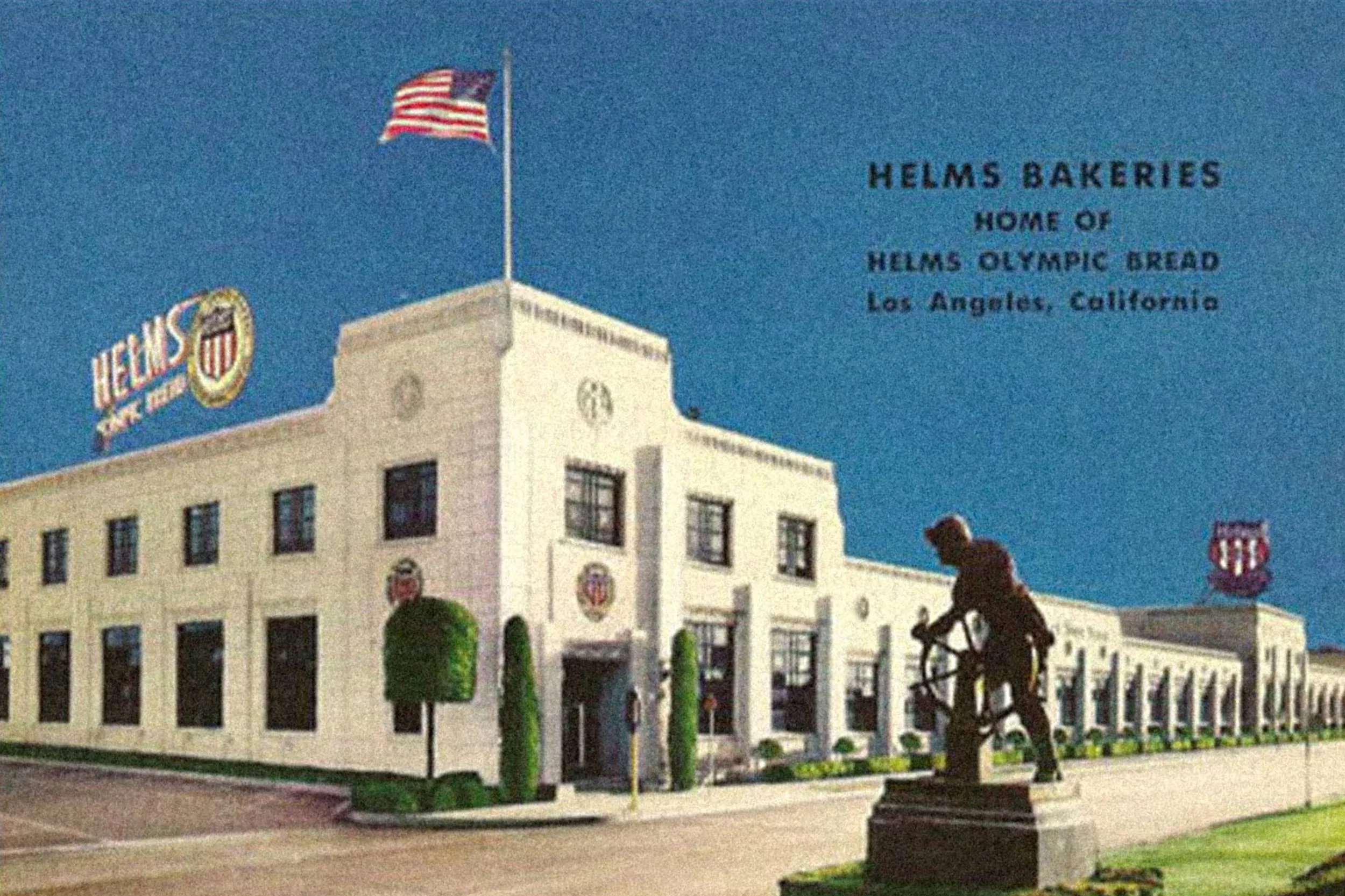
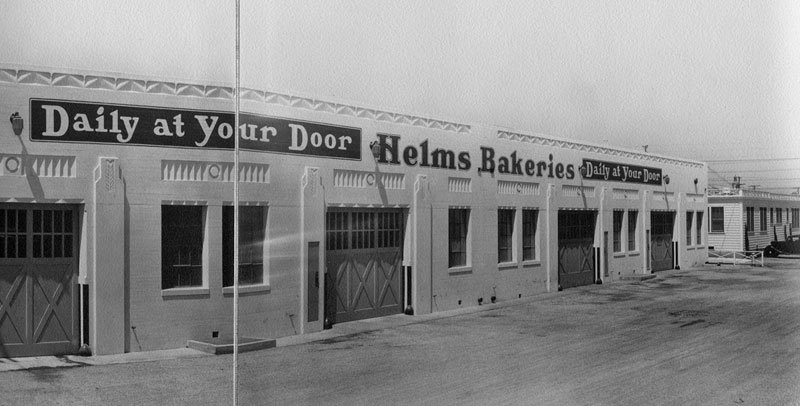
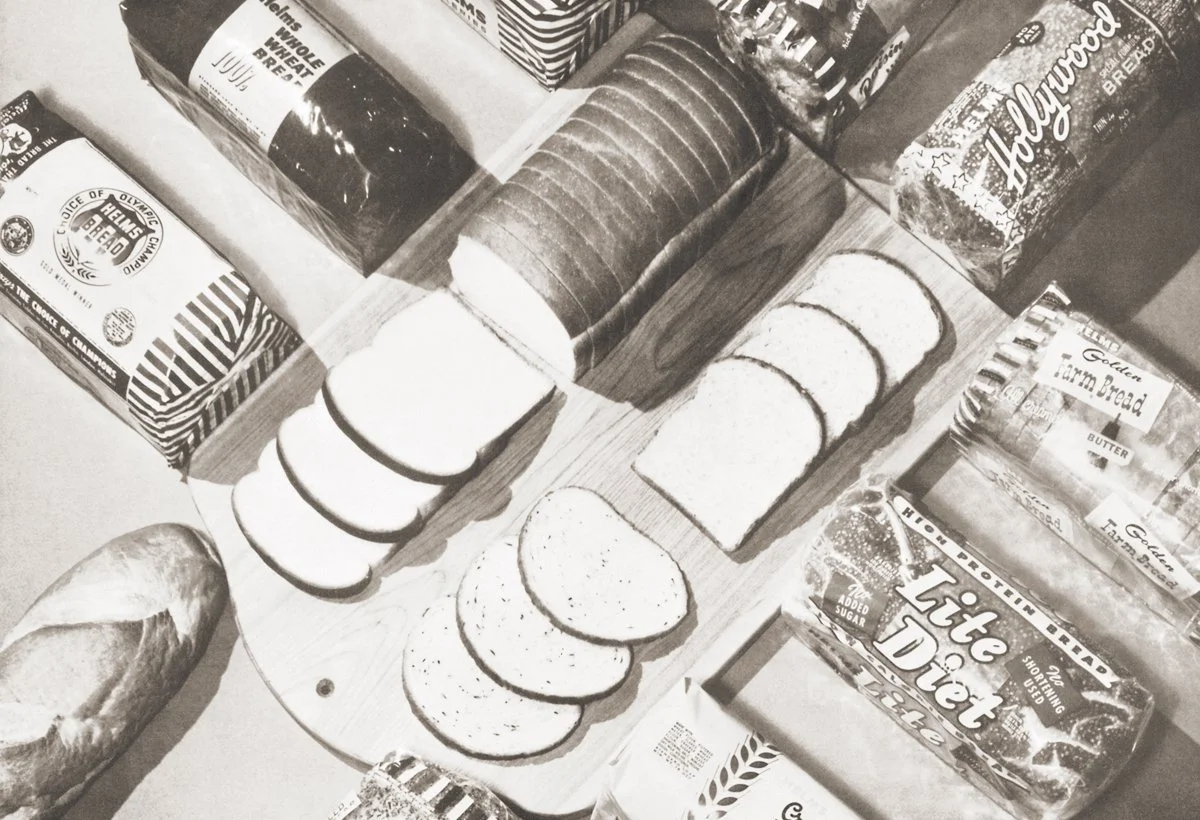
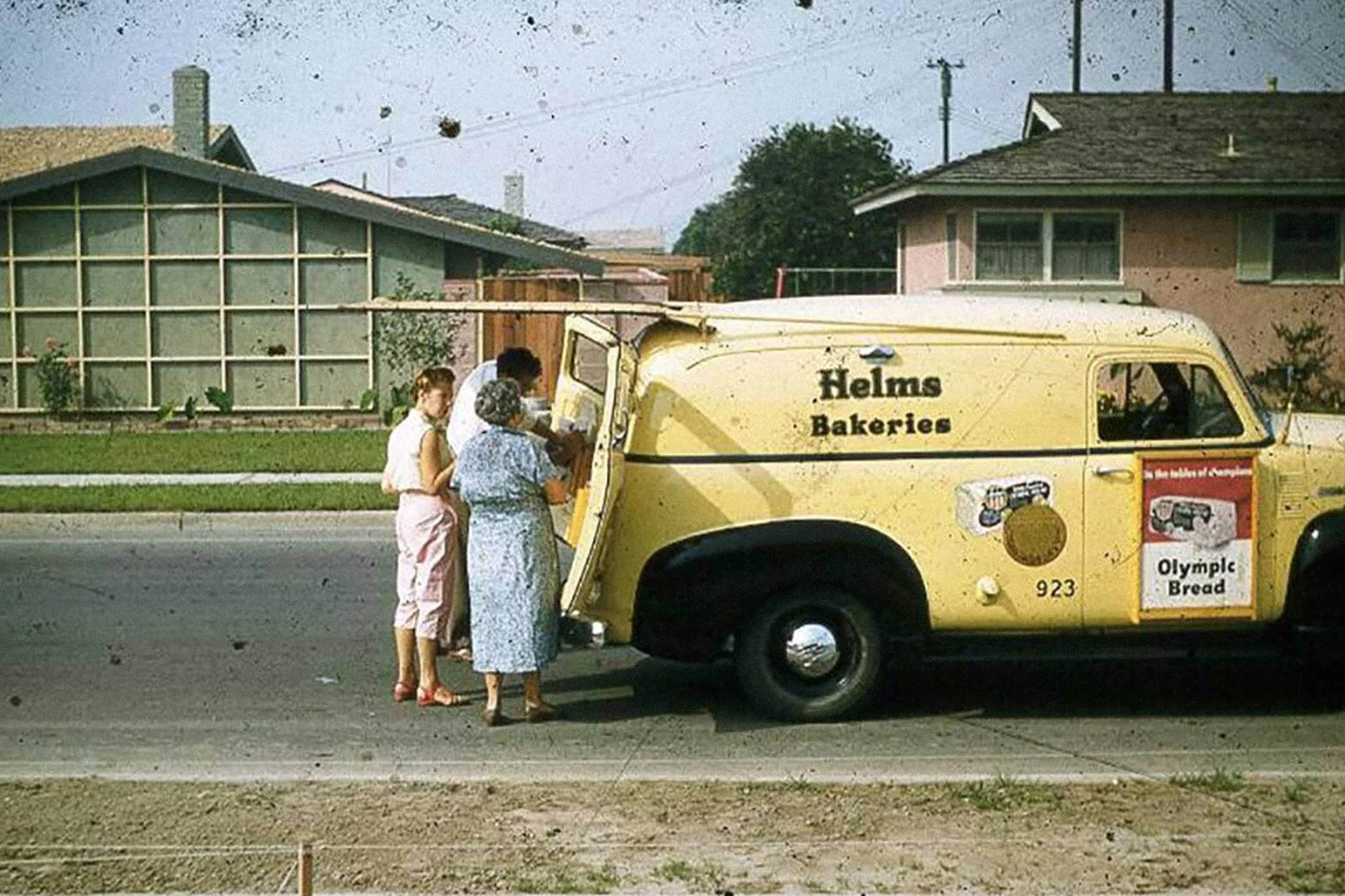
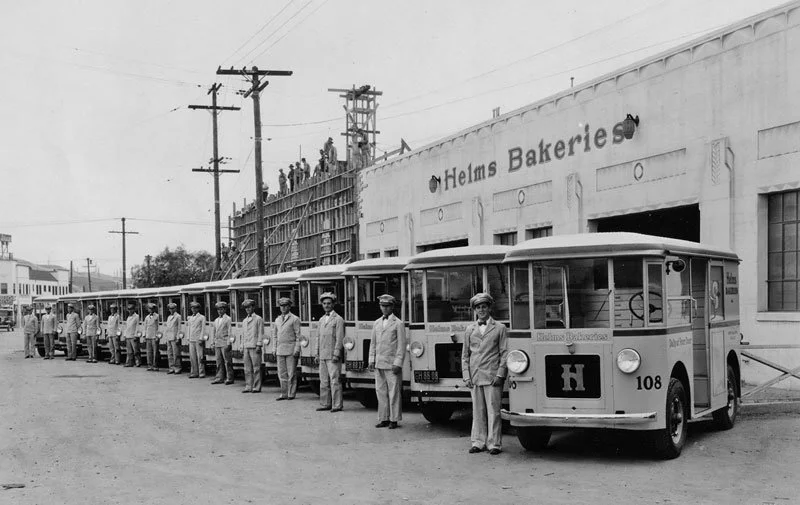
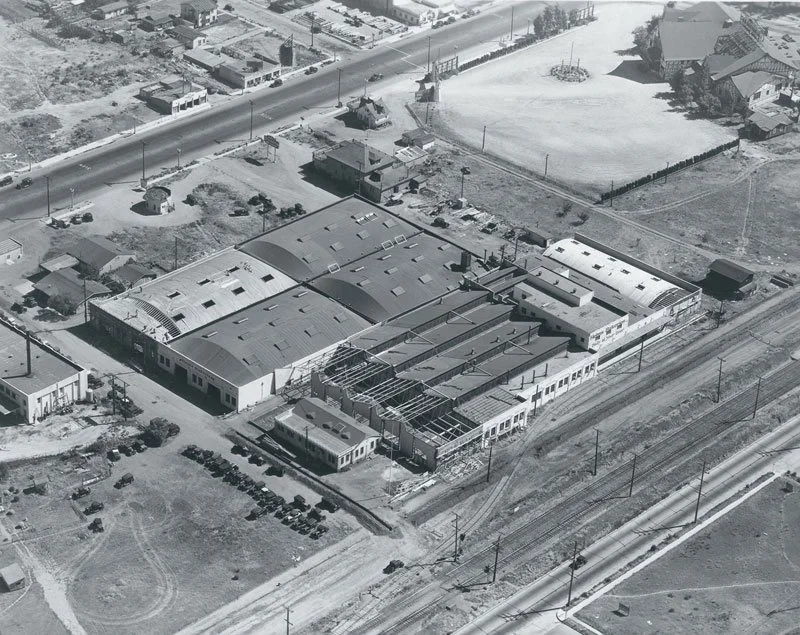
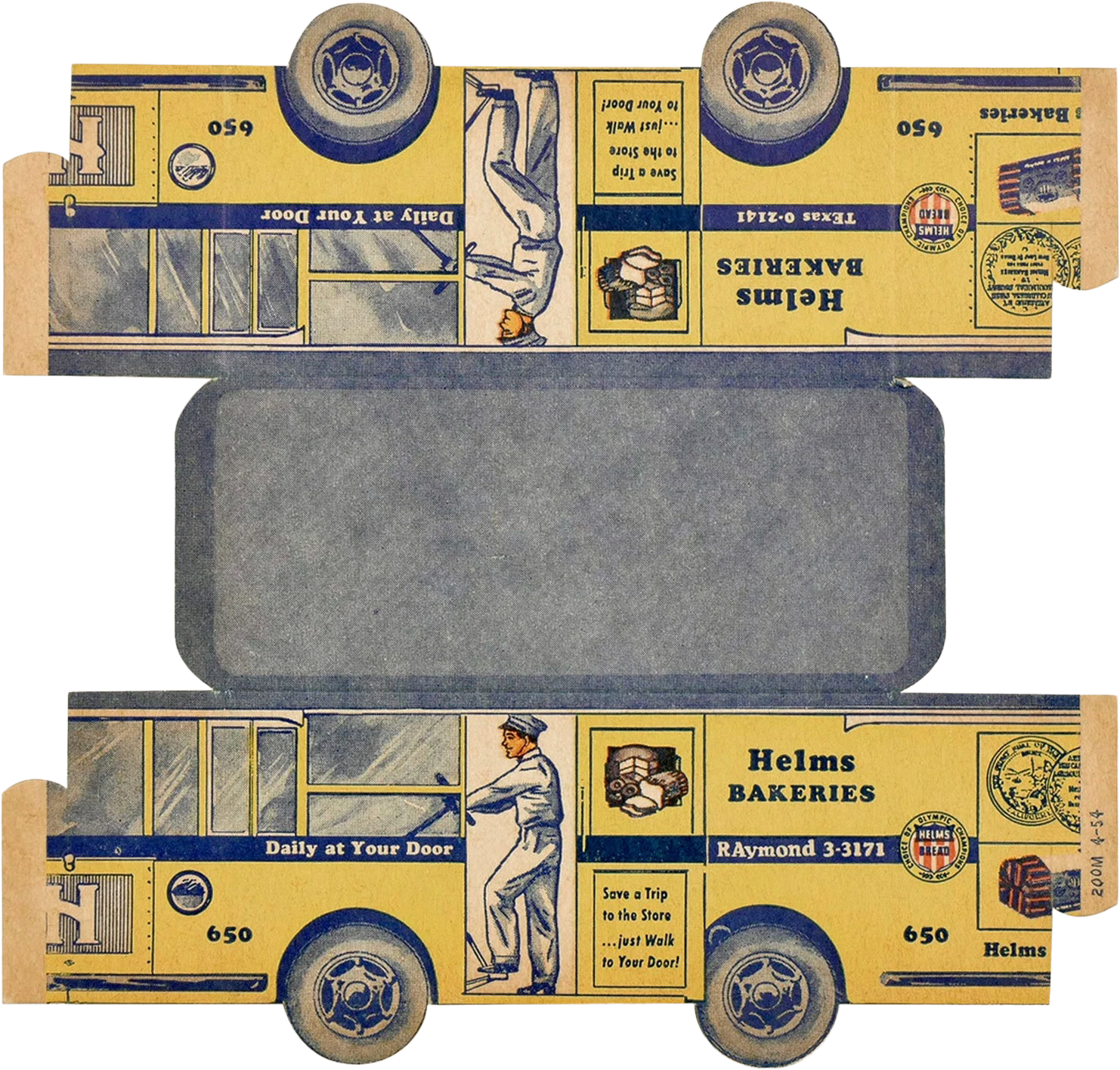
In March of 1931, just down Washington Boulevard from the lots, Paul Helms opened a new type of factory in Culver City. With thirty-two employees and eleven delivery vehicles (which Helms insisted were “coaches”—never “trucks”), the Helms Bakery produced a daily household staple instead of silver screen-bound feature films, but it operated on, effectively, the same two core “Dream Factory” principles: assembly-line production and carefully-considered presentation. A pioneer of its time in marketing, Helms Bakery built an iconic brand that survived its founder—and the bakery itself—firmly cementing its legacy within L.A.’s collective memory.
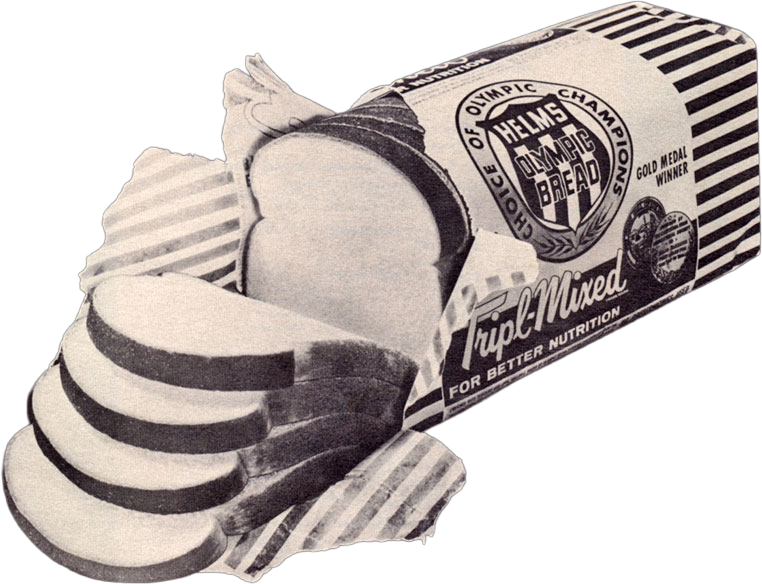
Following the 1932 games, for which Helms bore the title of “official bread,” the yellow coaches were inscribed with the words “Olympic Bread” and retained that tagline for decades. The delivery men, dubbed “Helmsmen,” were neatly outfitted in handsome, matching uniforms, announced themselves with a whistle, and stopped at every home that displayed the bakery’s printed “H” in its front window. The slogan was “Daily at Your Door,” and by mid-century, the fleet of yellow coaches totaled over five hundred, serving some three-and-a-half million households throughout the Los Angeles area, with the factory producing upwards of a million loaves of bread daily.
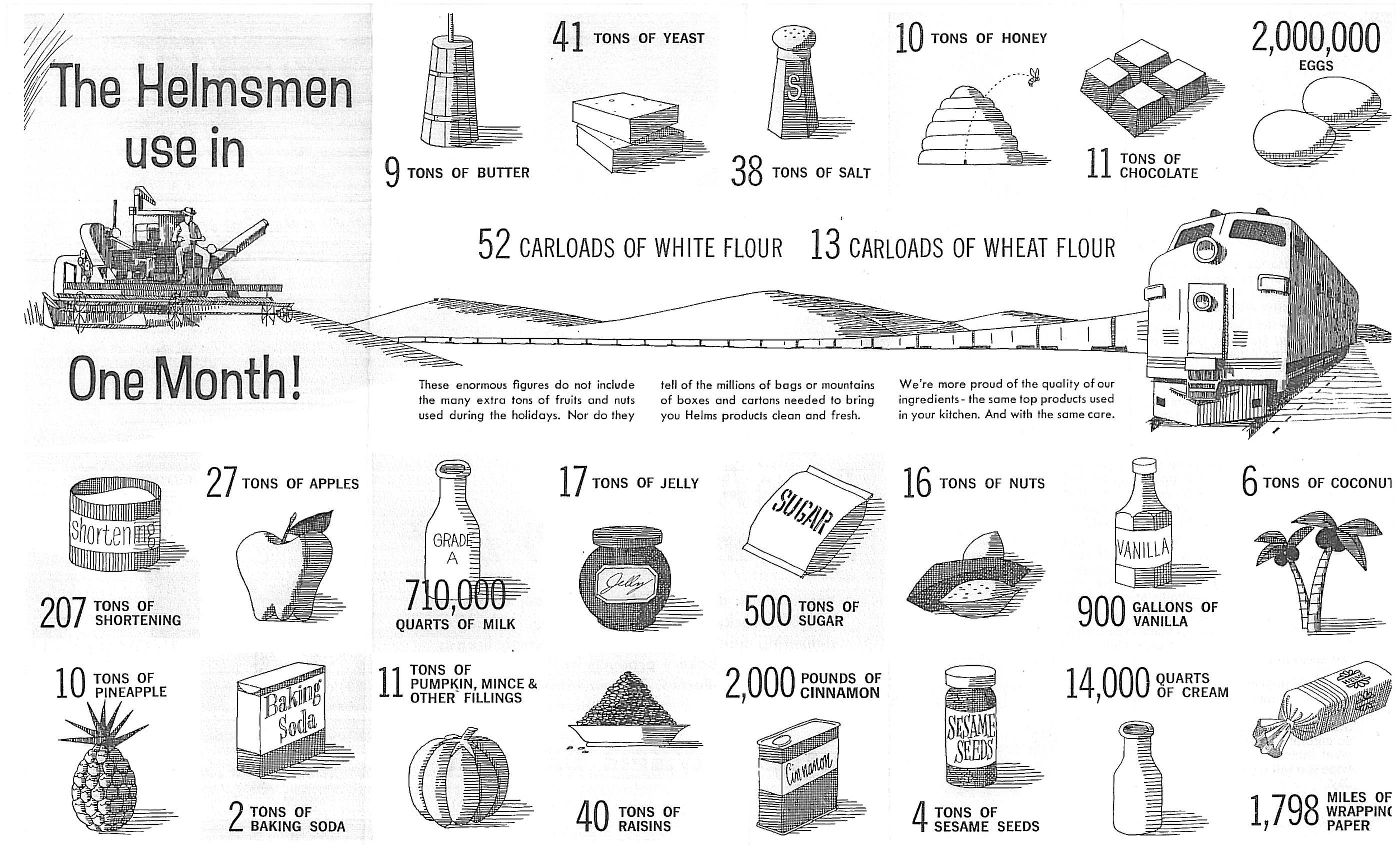
Courtesy of Helms Design District
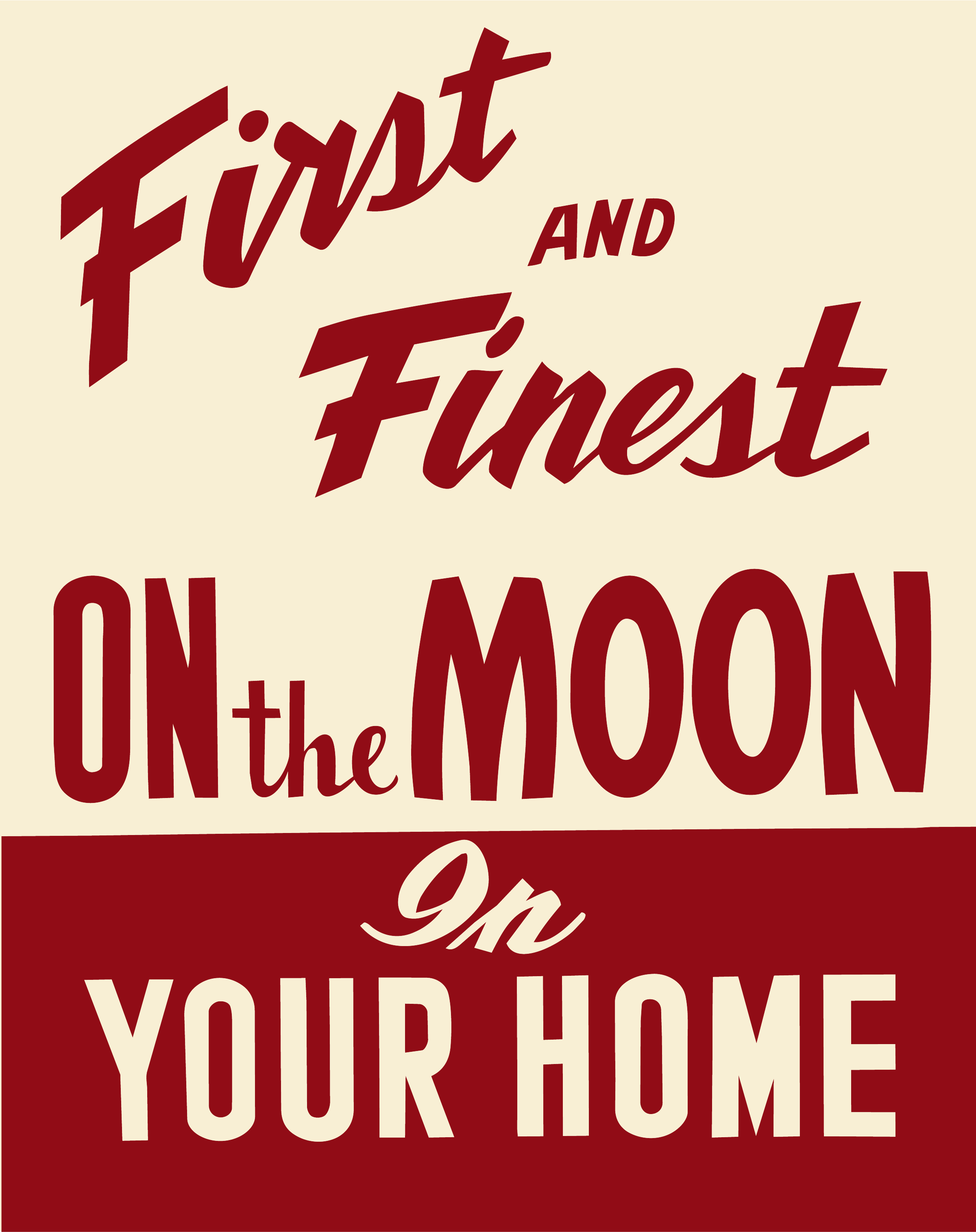
Not unlike the film studios located mere blocks away, Helms was, too, in a way, in the business of manufacturing dreams—of producing, at scale, the city’s lore. While “Hollywood” produced and distributed stories for export, Helms built its legend locally as a fixture, even ritual, of daily, household life for Angelenos citywide. The wrappers, coaches, the whistle—the costumes, props, sound effects, choreography, characters of the everyday—are key footholds upon which the legacy of a bakery that hasn’t made a loaf of bread in half a century remains, for many Angelenos, one of the first things cited when asked about their memories of the city’s past (upon hearing about this piece, an L.A.-native parent of one of the authors fondly recalled the distinctive sound of the Helms delivery whistle and his early captivation with the familiar, painted yellow coaches that, altogether, elevated the Helms bread delivered to neighbors’ doors daily, for him, to the imagined manna of his childhood). Helms Bakery’s last campaign, in 1969, secured the contract to be the bread supplier for Apollo 11, and the bakery proudly named their loaves the “First and Finest on the Moon.”
It seems only fitting that the city synonymous with mass-produced popular fictions is, in many ways, itself built on lore, myth, and legend that often outlives and outreaches its tenuous factual backings and absent formal records. Five months after Apollo 11 reportedly took Helms’ bread to the moon, the bakery shuttered its doors for good. The tales of Munchkin merrymaking entered the canon via Judy Garland on The Jack Paar Program in 1967. Despite nearly every credible account of the troupe’s stay dismantling her account, this popular myth has continued to permeate the city’s lore since, inspiring the 1981 film Under the Rainbow.
As Powdermaker notes, “Movies have a surface realism which tends to disguise fantasy and makes it seem true.” The achievable “quality of realness” inherent to the cinematic form “makes the escape into the world of movies”—whether into fact or into fiction—”so powerful, bringing with it conscious and unconscious absorption of the screen play’s values and ideas.” It’s no wonder, then, that this fable persists, backed not only by gossip but by a carefully constructed, widely-distributed enactment so hyperreal it feels as if it might just be fact—and makes for a much better story.
While recent decades have seen a sea change in the structure, operations, economics, and consumption surrounding Hollywood (and its surrounding “backlots”), the “Dream Factory”—in name, practice, and locale—continues to run, though it looks markedly different today than it did a century ago. Amazon Studios now runs out of the same lot Ince built in 1917, and Apple TV offices and production operate just down Washington Boulevard. Warner Bros.’ streaming offices operate from Ivy Station, and TikTok’s American headquarters sit just around the corner. The real estate firm that leased The Culver Studios to Amazon in 2017 called the property, at the time, “the crown jewel of the Heart of Screenland.” The trades covered the lot’s square footage.
That’s nothing new, here, though, in Hollywood’s so-called “backlot.”
The landmark Helms Bakery building hasn’t produced so much as a loaf of bread since 1969. What’s left of it now is a building, a sign, yellow coaches preserved in collectors’ garages, and a two-note whistle that longtime Angelenos can mimic on request, from memory.
Welcome to the dream factory.